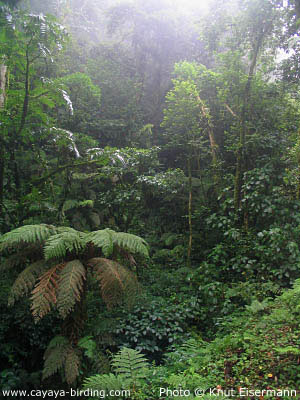
Cloud Forest
Tropical Mountain Cloud Forests are distributed throughout the whole tropical belt and partially in subtropical zones as well. This type of forest vegetation is only possible in condensation zones where warm, humid air, begins to cool and thus condense. This generally takes place at altitudes between 1,500 and 3,000 m (4,920-9,840 ft) (LaBastille & Pool 1978). On tropical islands the special climatic conditions of cloud forests sometimes occur at lower elevations down to 500 m (1,640 ft) and on continental mountains cloud forests sometimes occur at elevations up to 3,500 m (11,480 ft) (Hamilton et al. 1995). Mountain cloud forests are centers of endemism and hot spots for biodiversity (Garcia et al. 1998; LaBastille & Pool 1978; Long 1995; Leo 1995; Stotz et al. 1996; Toledo & Ordóñez 1993). This can be attributed especially to the specific a biotic conditions and the geographic isolation of most cloud forests and it shows the high value of these areas in terms of worldwide conservation of biodiversity.
Indigenous people have exploited the cloud forests of Mesoamerica for thousands of years, long before Spanish colonization (Peterson & Peterson 1992). Nonetheless, at the present time, human pressure on cloud forests has increased drastically, which is, in turn, resulting in a critical threat to this ecosystem. In Guatemala, Mayan people most traditionally inhabit the mountainous areas of the country. Discrimination and possession of lowlands since the time of Spanish colonization in the 16th century has forced the indigenous population to move up into these areas, which are not appropriate for agricultural use (z.B. Sterr 1994). While the method of slash and burn farming was used by the Maya over a thousand years ago (Dunning 1996; Grube 1997; Turner & Harrison 1983; Killion 1992), this traditional lowland cultivation method is not appropriate for the steep slopes where Mayans farm today, and results increasing shrinkage of the forested area, due to forest fires, and increased erosion of the fertile topsoil. Only a few decades ago the impact of this shifting cultivation towards mountain areas was evaluated as trivial (Lamprecht 1961), but in the beginning of the 1980's, 21% of the forested area in the tropical belt had already been converted into agricultural land, with an annual increase of 1.25% since that time (Goldammer 1993 nach FAO 1985). In Guatemala between 1990 and 2000 the forested area decreased annually at a rate of 1.7% (FAO 2003).
The importance of cloud forests for the conservation of watersheds, as centers of biodiversity and as an attraction for eco-tourism was recognized three decades ago and resulted in the establishment of several protected areas throughout Mesoamerica (Bowes et al. 1969; Daugherty 1973; LaBastille 1973; 1974b; LaBastille & Pool 1978; Weber 1973). Initiatives for the conservation of this kind of ecosystem continue at present (e.g. Mühlenberg et al. 1989; Fundación Defensores de la Naturaleza) but need much more help. Eco-tourism and birdwatchers provide a positive impact, helping to conserve and provide added local stimulus to conserve primary forests throughout Mesoamerica. Your visit is not only exciting for you but very important for conservation activities!
References
Bowes, A. L., A. LaBastille & D. G. Allen (1969): Biology and conservation of the Quetzal. Biological Conservation 1, 197-306.
Brown, A. D. (1995): Ecology and conservation of the Argentine montane forest. In: Hamilton, L. S., J. O. Juvik & F. N. Scatena (eds.): Tropical montane cloud forests. Springer, New York, 107-115.
Daugherty, H. E. (1973): The Montecristo cloud-forest of El Salvador: a chance for protection. Biological Conservation 5, 227-230.
Doumenge, C., D. Gilmour, M. R. Pérez & J. Blockhus (1995): Tropical montane cloud forests: Conservation status and mangement issues. In: Hamilton, L. S., J. O. Juvik & F. N. Scatena (eds.): Tropical montane cloud forests., Springer, New York, 24-37.
Dunning, N. P. (1996): Coming together at the temple mountain: environment, subsistence and the emergence of lowland Maya segmentary states. In Grube, N. (ed.): The emergence of lowland Maya civilization: the transition from the preclassic to the early classic. Acta Mesoamericana 8, 61-69.
FAO (1985): Tropical forestry action plan. FAO, Rome, 159 p.
FAO (2003): State of world's forests. Food and Agriculture Organization of the United Nations, Rome.
Fundación Defensores de la Naturaleza (1990): Reserva de la Biósfera Sierra de las Minas. Plan Maestro 1992-1997, 54 p.
Garcia, S., D. M. Finch & G. C. León (1998): Patterns of forest use and endemism in resident bird communities of north-central Michoacán, Mexico. Forest Ecology and Management 110, 151-171.
Goldammer, J. G. (1993): Feuer in Waldökosystemen der Tropen und Subtropen. Birkhäuser Verlag, Basel, Boston, Berlin, 251 p.
Grube, N. (1997): Die Geschichte der Maismenschen. In Allebrand (ed.): Die Erben der Maya: indianischer Aufbruch im Land der Maya. Horlemann Verlag, Bad Honnef, 20-68.
Hamilton, L. S., J. O. Juvik & F. N. Scatena (1995): The Puerto Rico Tropical Cloud Forest Symposium: Introduction and Workshop Synthesis. In: Hamilton, L. S., J. O. Juvik & F. N. Scatena (eds.): Tropical Montane Cloud Forest. Springer, New York, 1-23.
Killion, T. W. (ed., 1992): Gardens of prehistory: the archaeology of settlement agriculture in Greater Mesoamerica. University of Alabama Press, Tuscaloosa, 334 p.
LaBastille. A. (1974b): Ecological survey of Volcano Barú National Park, Panamá. IUCN Misc. Public. 6, 77 p.
LaBastille, A. & D. J. Pool (1978): On the need for a system of cloud-forest parks in Middle America and the Caribbean. Environmental Conservation 5, 183-190.
Lamprecht, H. (1961): Tropenwälder und tropische Waldwirtschaft. Beiheft der Zeitschrift für Schweizerisches Forstwesen 32, Fa III 219 p.
Leo, M. (1995): The importance of tropical montane cloud forests for preserving vertabrate endemism in Peru: The Río Abiseo National Park as a case study. In: Hamilton, L. S., J. O. Juvik & F. N. Scatena (eds.): Tropical montane cloud forests., Springer, New York, 198-211.
Long, A. J, (1995): The importance of tropical montane cloud forests for endemic and threatened birds. In: Hamilton, L. S., J. O. Juvik & F. N. Scatena (eds.): Tropical montane cloud forests., Springer, New York, 79-106.
Lush, C. (1995): Cloud forest of the Rwenzori Mountains, Uganda: research and management possibilities. In: Hamilton, L. S., J. O. Juvik & F. N. Scatena (eds.): Tropical montane cloud forests., Springer, New York, 212-222.
Medeiros, A. C., L. L. Loope & R. W. Hobdy (1995): Conservation of the cloud forests in Maui County (Maui, Moloka'i, and Lana'i), Hawaiian Islands. In: Hamilton, L. S., J. O. Juvik & F. N. Scatena (eds.): Tropical montane cloud forests., Springer, New York, 223-233.
Mühlenberg, M. & Hovestadt, T. & Unger, D. (1989): Schutz des Nebelwaldes in Guatemala. unpubl. Bericht zum GTZ - Projekt PN 87.2253.0-01.100 "Bäuerliche Waldwirtschaft", Fabrikschleichach/Univ. Würzburg
Peterson, A. A. & A. T. Peterson (1992): Aztec exploitation of cloud forests: tributes of liquidambar resin and Quetzal feathers. Global Ecology and Biogeography Letters 2, 165-173.
Primack R. B., D. B. Bray & H. A. Galletti (1997): Timber, Tourists and Temples: Conservation and Development in the Maya Forest of Belize, Guatemala, and Mexico, Island Press, Washington.
Raynor, B. (1995): Montane cloud forests in Micronesia: status and future management. In: Hamilton, L. S., J. O. Juvik & F. N. Scatena (eds.): Tropical montane cloud forests., Springer, New York, 274-283.
Sterr, A. (1994): Guatemala. Lautloser Aufstand im Land der Maya. Interviews-Analysen-Reportagen. Köln, 287 S.
Stotz, D. F., J. W. Fitzpatrick, T. A. Parker III & D. K. Moskovits (1996): Neotropical birds: ecology and conservation. University of Chicago Press, Chicago, 478 p.
Toledo, V. M. & M. de J. Ordóñez (1993): The biodiversity scenario of Mexico: a review of terrestrial habitats. In: Ramamoorthy, T., R. Bye & Fa. J. A. Lot (eds.): Biological diversity of Mexico. Oxford University Press, New York, 757-777.
Tum, R. M. & G. Budowski (1997): Cloud forest in the mountains of Guatemala: support needed for providing protected status. Mountain Research and Development 17, 91.
Turner, B. L. & P. D. Harrison (1983): Pulltrouser swamp: ancient Maya habitat, agriculture, and settlement in northern Belize. University of Texas Press, Austin, 294 p.
Weber, B. (1973): National Park creation in a developing nation: a case study of Dominica, West Indies. unpubl. Ph.D. dissertation, Colorado State University, Fort Collins, Colorado, 260 p.
Young, K. R. & B. León (1995): Distribution and conservation of Peru's montane forests: interactions between the biota and human society. In: Hamilton, L. S., J. O. Juvik & F. N. Scatena (eds.): Tropical montane cloud forests., Springer, New York, 363-376